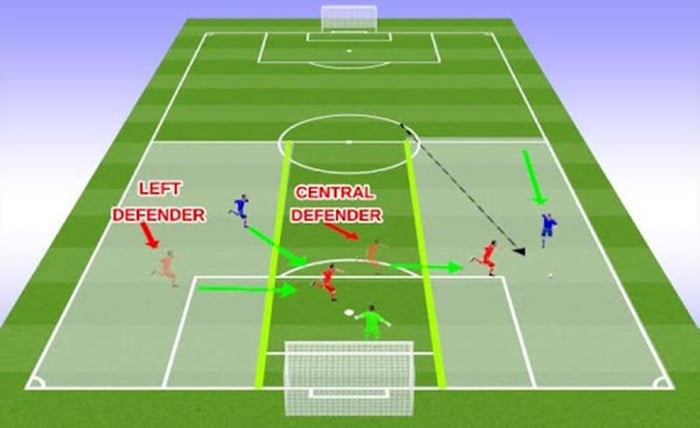
What is a full-back is a question many people ask when learning about modern football tactics. Let’s analyze the responsibilities, skills, movement patterns, and influence of this position within a team formation.
What Is a Full-Back in Modern Football?
Definition and Position on the Pitch
What is a full-back can be simply understood as a defensive position operating along the two flanks, commonly known as the right-back or left-back. A player in this role operates deeper than the wide midfielder and is responsible for protecting the area near the touchline while also helping teammates control the space in front of the penalty area.
In traditional football, full-backs were primarily responsible for defending, marking opponents, and preventing crosses. However, modern tactics have significantly changed the demands placed on this position. A good full-back must not only be strong in challenges but also possess speed, passing ability, game awareness, and the ability to contribute to building play.
According to Xoilac TV, the development of possession-based football has increasingly required full-backs to participate in ball circulation. They may move into central areas, push forward like midfielders, or repeatedly overlap on the flank to create space for teammates to exploit.
Differences Between Traditional and Modern Full-Backs
The biggest difference lies in their range of movement and tactical mindset. Traditional full-backs generally prioritize maintaining their position, protecting the space behind them, and moving forward only when the situation allows. Modern full-backs, meanwhile, can appear in various areas depending on the coach’s tactical system.
When the team has possession, the player may move close to the touchline to stretch the opposition defense. If the system requires greater control in midfield, they may move inside to create a numerical advantage. Therefore, the question what is a full-back cannot be explained simply by their position on the pitch but must be understood in relation to the entire tactical structure.
Fans who follow xem xôi lạc can often notice this change through the way top full-backs constantly switch between different roles. A well-timed forward run can create an attacking opportunity, but a single incorrect movement can also leave dangerous space behind.
Key Responsibilities and Requirements of a Full-Back
Defensive Ability on the Flank
The fundamental responsibility of a full-back remains protecting the defensive area on the outside. The player must know how to maintain distance from the center-backs, anticipate the opponent’s runs, and proactively prevent dangerous bursts of pace.
In one-on-one situations, choosing the right moment to close down the opponent is particularly important. If the defender commits too early, the attacker may use a feint to get past them; if the defender drops too deep, the attacking player will have enough space to pass or cross. Therefore, defensive awareness must go hand in hand with observation and anticipation.
According to Xoilac Z, outstanding full-backs do not necessarily need to make a large number of sliding tackles. They can resolve situations by choosing the right position, narrowing passing angles, and forcing opponents to move the ball toward less dangerous areas.
Supporting Attacks and Creating Width
When the team builds play through the central areas, full-backs can push forward to create width, stretch the defense, and open spaces for midfielders or forwards to penetrate. Overlapping runs are also a familiar tactical option.
Those who regularly follow kqbd truc tuyen on xem xôi lạc may notice that many matches are decided by the seemingly understated contributions of full-backs. An accurate low cross, a cutback toward the second line, or a well-timed movement to drag away a defender can all have a direct impact on a goal.
Speed, Stamina, and Transition Ability
This position requires an excellent physical foundation because the player must constantly switch between defensive and attacking responsibilities. During the same attacking move, they may run more than half the length of the pitch to support their teammates before immediately returning to position when possession is lost.
Speed helps full-backs deal with counter-attacking situations, while stamina determines their ability to maintain intensity throughout the match. In addition, short-distance acceleration is particularly important when competing against technically gifted and fast wingers.
According to Xôi Lạc Z, highly organized teams often require full-backs to carefully control when they move forward. The presence of open space ahead does not always mean the player should immediately push forward, because there is always a risk of a counter-attack developing behind them.
Tactical Awareness and Coordination
In addition to physical qualities, tactical awareness is a decisive factor in determining a player’s level. A full-back must understand when to hold position, when to move inside, when to overlap, and when to drop back to protect the center-backs.
Platforms such as Xoi Lac TV often allow viewers to observe these tactical details clearly through individual matches. Coordination with the wide midfielder is also extremely important. If both players remain wide, the team may lack numbers in central midfield; if both move inside, the flank can become vulnerable to opposition attacks. Therefore, every movement needs to be based on the position of teammates and the current state of play.
Qualities That Make an Outstanding Full-Back
To perform effectively, a player needs to combine multiple qualities rather than relying solely on speed. Game reading, close control in tight spaces, crossing, long passing, and tackling can all determine the quality of a performance.
A well-rounded full-back must also possess mental stability. After moving forward to support an attack, they must quickly transition into a defensive role if their team loses possession. This is why players with strong tactical awareness often maintain greater effectiveness during intense matches.
When watching xem xôi lạc, viewers can focus on how players handle transition situations rather than paying attention only to goals or kqbd truc tuyen. It is precisely those well-timed recovery runs and proa